
Garden Maintenance Teddington: Recycling and Sustainability
Garden Maintenance Teddington is committed to an eco-friendly waste disposal area and to creating a sustainable rubbish gardening area across every job. Our approach to Teddington garden maintenance goes beyond pruning and planting: we design workflows that prioritise reuse, recycling and low-carbon operations. We measure success in tonnes diverted from landfill and in local community benefit. As a local garden services provider we align our daily operations with the borough's approach to waste separation — separating food waste, garden green waste, paper/card, glass and mixed recyclables — and we apply that framework to how we handle waste on site.
We set a clear company-wide recycling percentage target: 70% of all garden and site waste should be diverted from landfill through recycling, composting or reuse within 12 months of implementation. That target applies to branch-level work within Teddington, and it informs how we collect, sort and transport materials. The target is deliberately ambitious to encourage innovation in our sustainable rubbish gardening area, including on-site composting and seasonal reuse of cuttings and soil.
How our eco-friendly waste disposal area works
Our operational steps for sustainable rubbish gardening area include clear separation at source, dedicated green waste sacks or bins, and a chain-of-custody for materials that can be reused or donated. On each job our teams carry separate containers for:
- green cuttings and branches
- compostable food and plant material
- clean soil and turf
- wood for chipping and reuse
- packaging and plastics sorted per borough rules
 We also operate a mobile sorting zone so that bulky jobs generate less mixed waste. Branches are chipped and either used as mulch in the same garden or collected for local community green spaces. Turf and good topsoil are retained for reuse; any residual material that cannot be composted is sent to approved transfer stations for further processing.
Local transfer stations and processing partners
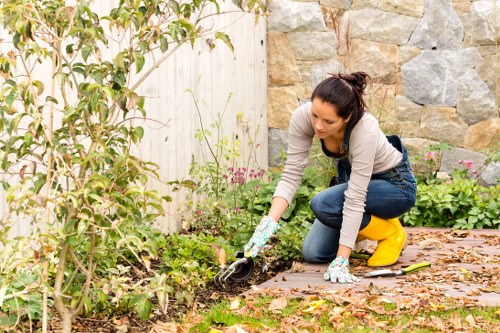 We work with local transfer stations and household recycling centres in and around Richmond upon Thames and neighbouring boroughs to ensure compliant, low-impact disposal. Typical destinations include borough-authorised transfer centres and nearby municipal recycling facilities in Kingston and Isleworth where green waste and wood are composted or prepared for renewable energy use. Using authorised transfer stations gives our customers confidence that materials labelled as recycled are actually processed under the boroughs' waste separation standards.
Our route planning reduces the number of depot visits and consolidates loads to decrease vehicle miles. We log every load so that we can report actual recycling percentages back to our internal sustainability dashboard, which supports continuous improvement and transparency across our Teddington garden maintenance teams.
Partnerships with charities and community reuse schemes are central to our sustainable rubbish gardening area. We partner with local community gardens, allotment associations and food-growing projects to donate healthy soil, potted plants and reusable planters. We also coordinate with charities that accept tools and equipment in good condition so that useful items avoid being thrown away. These collaborations extend the life of materials and support social benefits in the local area.
Examples of partnership outcomes include compost donations to community allotments, donated raised beds for schools, and redistribution of oversized pots to community growing initiatives. These activities reinforce a circular approach to Teddington garden maintenance: waste from one site becomes an input for another.
Low-carbon transport and logistics are another pillar of our sustainability plan. We are transitioning to a fleet of low-emission vans and vehicles adapted for garden services. That includes battery-electric vans for short urban jobs, plug-in hybrid vans for longer journeys, and cargo e-bikes for small-scale deliveries and tool transport within Teddington town centre.
 Low-carbon vans reduce both our operational emissions and disturbance in built-up areas. Noise and exhaust reductions improve the local environment while supporting the borough's net-zero goals. Where EV charging access is limited we deploy hybrids and optimise our schedules to reduce deadheading and idling. All drivers follow eco-driving practices and we plan multi-job routes to minimise overall mileage.
To support transparency and improvement we monitor recycling performance and publish internal targets. Our measurable commitments include:
- 70% recycling target for green and related garden waste within one year
- Quarterly audits of material flows to local transfer stations
- Annual review of fleet emissions and electrification progress
We also align with the boroughs' waste separation messaging so customers can complement our efforts by separating waste at source. Where household collections provide separate food waste and green waste bins, our on-site sorting mirrors that system to reduce contamination and increase recycling yields.

Making sustainable garden maintenance accessible
Our approach to sustainable rubbish gardening area balances practicality and environmental ambition. We provide clear information to customers about what can be recycled, how donations to charities are handled, and how reclaimed materials are reused. By integrating these practices into every job, our Teddington garden maintenance service helps create healthier soils, greener public spaces and reduced landfill dependency.
In summary, our commitments are straightforward: operate an effective eco-friendly waste disposal area, meet or exceed a 70% recycling percentage target, partner with community groups and charities for reuse, and run a low-carbon fleet to reduce transport emissions. These measures make our Teddington gardening maintenance both practical for clients and beneficial for the local environment.